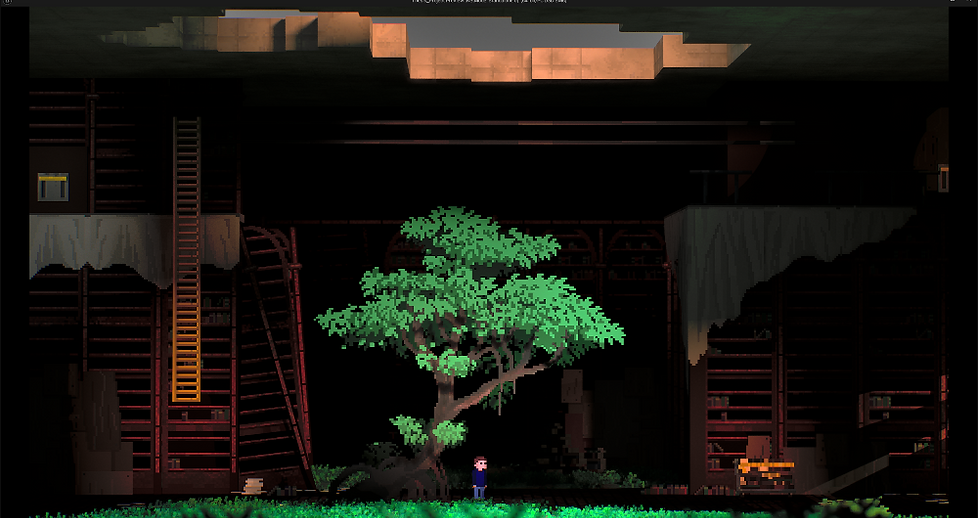

Thesis Project for Game and Media Design at The Royal Danish Academy
Engine: Unreal Engine 5
Platform: PC
Period: 4 months
Role: Everything except some voice acting
Tools: Blueprint, Aseprite, Blender
Exam grade: 12/A

This game comes from my heart. It is a culmination of my life thus far. It is both a critique of formulas and over-intellectualization in academia and life, a self-exploration of my time at the academy, and a love letter to the artistic value a video game can have. Games can be much more than profitable entertainment. It can be an invitation to empathy.
LEVEL DESIGN:
-
2.5D platformer inspired by Playdead's Inside's responsive, tactile and UI-free gameplay.
-
Variety in level sections that all build upon each other towards a twisty climax.
-
Introduces new gameplay elements at a steady pace.
-
Emphasis on composition to direct the player and tell the story.
-
Sound used to emphasize wanted emotional experiences.
-
Each level section has something unique and memorable to only that section.
Narrative Design:
-
Cutscenes with voice acting.
-
Focus on embedded narrative architecture. The story is mostly told implicitly through the audiovisuals and gameplay moments.
-
Implicit storytelling means leaving things up to the player to fill in with own ideas.
-
Each moment, handcrafted to precision to tell the story needed for an emotional powerful experience.
PROCESS DOCUMENTATION

Blockout
Early phase iteration was done with simple blockouts. The process allowed testing the ideal scope and pipeline. Some factors were more important than others.
Important factors:
-
Layout, scale and proportions.
-
Fixed camera compositions.
-
Composition, color and lighting to support story and gameplay.
-
Gameplay pacing (walking, navigation, obstacles, visual narrative etc.).
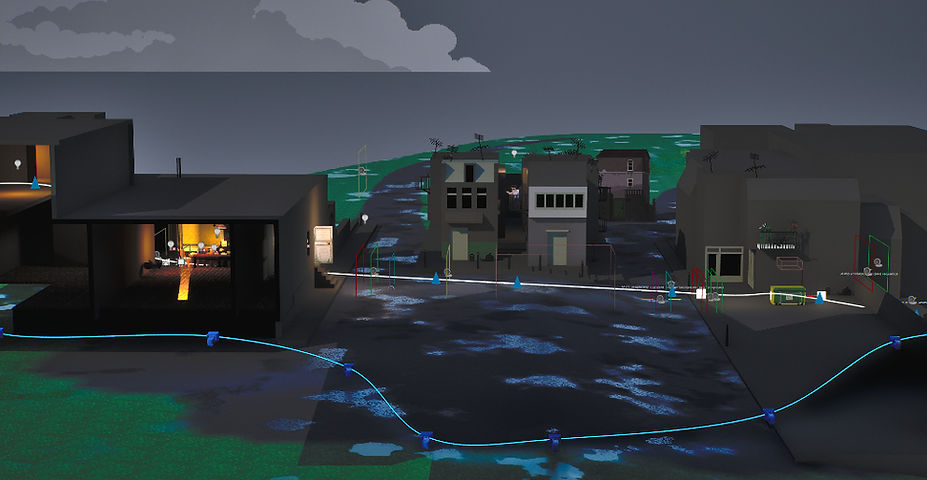
Example: development of chase section
The picture gallery below showcases a variety of elements from the game:
-
Composition, color and lighting for mood and narrative impact.
-
Gameplay tells the story of being on the run in a dangerous world.
-
Combining different gameplay elements (ladders, pushables and NPCs).
Check it out:

Started with the idea of distracting the enemies by dropping a box.

The yellow box on the ground was used to reach the ladder.

1. Decided to remove the yellow box on the ground to simplify and added that idea into another puzzle. 2. The area also got bigger to allow for a longer chase. 3. Ladder was moved right of the box, to allow for an introduction to the goal first: the box on the ledge.
Started with the idea of distracting the enemies by dropping a box.
Finished section with explanation text
Below is an explanation of the chase section's level design.
Click for full picture.

Lighting, color and composition tells a story
The game is ~30 min. and features a story with a beginning, middle and end. To emphasize the journey and changes which surround the protagonist within the short ~30 min., lighting, color and composition varies widely. Sections change from sunrise in a rural town to bright daylight fields to foggy urbanism in the city and then finally to clear skies back in the town now abandoned. It all is designed to support an implicit narrative of an adult reliving his childhood trauma of being a child on the run.
Check it out:


3D environment
To achieve the 2.5 pixel art style, I developed a pipeline involving a mix of flat pixelated png's and 3D models made in Blender.

Story
The story is about the generational legacy of trauma in a family, and the act needed to break the cycle.
To fit a traditional narrative-structure with a beginning, middle and end - where the main character's changes are not abrupt - I adopted an untraditional continuity in the narrative. For most of the game, you play through the main character's skewed reenactments of his stitched-together memories. This allowed a sense of passage of time when you finally go back to the present where he is an adult.
(Click for full picture)

Motivation

Motivation
-
To make a 2.5D pixel art and 3D hybrid stylized adventure game inspired by Playdead's Inside.
-
To create a game that comes from my heart, by reforming my own memories into a story and gameplay and using my favorite skills.
-
To make something that's non-formulaic but original.
ABSTRACT
This thesis explores the elusive concept of "heart" in media, particularly in video games, and investigates whether it is possible to intentionally create a game with heart. The project began with a personal and philosophical inquiry: what does it truly mean when we say a piece of media "has heart"? Is it a definable quality, or is its very nature adverse to definition?
To approach this question, I created Muddy Hearts, a 2.5 D pixel-art narrative-driven game that draws directly from my own life, memories, and relationships. Rather than only following external design formulas, I relied on intuition, improvisation, and emotionally driven decision-making to guide the creative process to tap from my latent subconsciousness. Through the theoretical lens of Gaston Bachelard’s The Poetics of Space and Mark J. P. Wolf’s Building Imaginary Worlds, I examined how resonance and reverberation – emotional echoes between creator and player – can foster a sense of heart.
The project combined artistic creation with academic inquiry: defining heart through theory, embodying it through design, and evaluating it through playtesting. Testers were asked to reflect on their emotional engagement, the authenticity of the experience, and whether they sensed a human intention behind the work. The findings suggest that heart is not solely found in the form of a video game, but rather in the perceived sincerity and authenticity of the creator’s intention. The player’s subconscious understanding of its form-giving. Players all identified heart in Muddy Hearts, even when its themes did not directly remind them of their own experiences, reinforcing the idea that heart stems from the transfer of lived experience, not from a formulaic process.
This thesis proposes an approximation of heart as an emergent property rooted in the solidarity between authentic memory and imaginative transformation. While acquiring a precise definition is challenging, the presence of heart can be felt when genuine human experience is transferred into the form of a video game – an act that may only be possible when the creator is willing to let go of control.
Screenshots